
Our Stained Glass Windows
At First Presbyterian we have long been proud of our striking stained glass windows. With technical and artistic mastery, the designs run the perimeter of the sanctuary in a journey through the Bible. Beginning on the west side of the building is the Old Testament, followed the Sacraments, the Psalms, the new testament windows to the east, and finally the Twelve Apostles found in the narthex.
Though the original windows were designed in 1964, those on display today were re-fashioned in 1991 after a fire. The only original stained glass that remains is found in the doors. Though the symbols remained the same they are not identical as the new windows required new patterns and designs. The results far passed expectations and today the beautiful windows awe onlookers with their brilliant colors and great attention to detail.
Keep reading to learn more about the Old and New Testament windows. To garner more information or learn about the other delightful stained glass windows of the sanctuary, see the link below:
The New Testament Windows
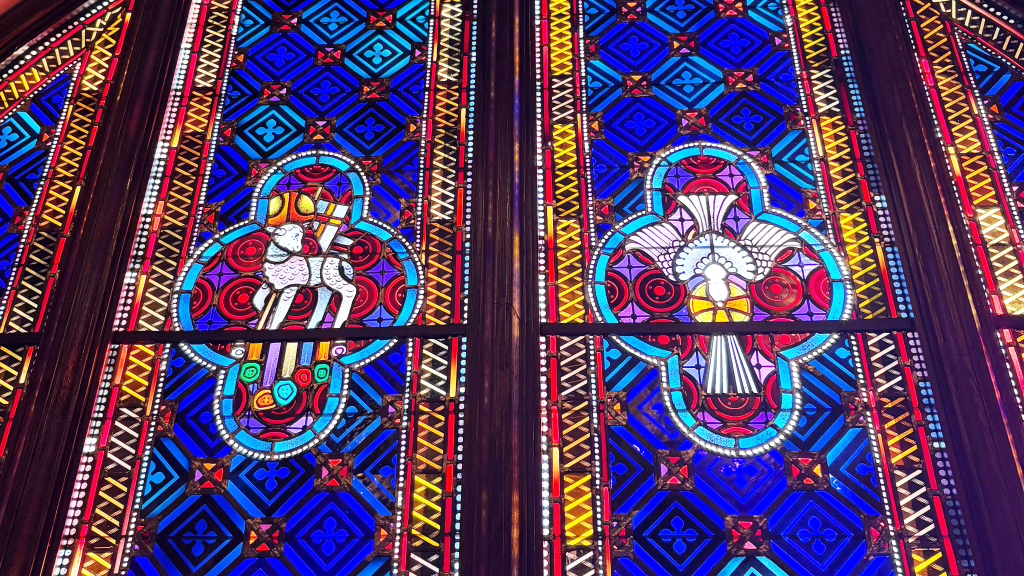
The Lamb of God
“Worthy is the Lamb who was slain to receive power and riches and wisdom, and strength and honor and glory and blessing!” – Revelation 5:12
The Lamb of God in victory is a symbol of Christ in heaven at the right hand of God. Often in Christian artworks the victorious Lamb stands upon an empty tomb, but in our New Testament window the Lamb is standing on the seven seals which hang from seven ribbons, representing the seven seals opened by the Lamb in the book of Revelation.
The Dove of the Holy Spirit
“… heaven was opened, and he saw the Spirit of God descending like a dove and alighting on him. And a voice from heaven said, ‘This is my Son, whom I love; with him I am well pleased.'” – Matthew 16-17
The three radiant beams of the halo around the head of the dove indicate that the dove is one of the persons of the Holy Trinity of God.
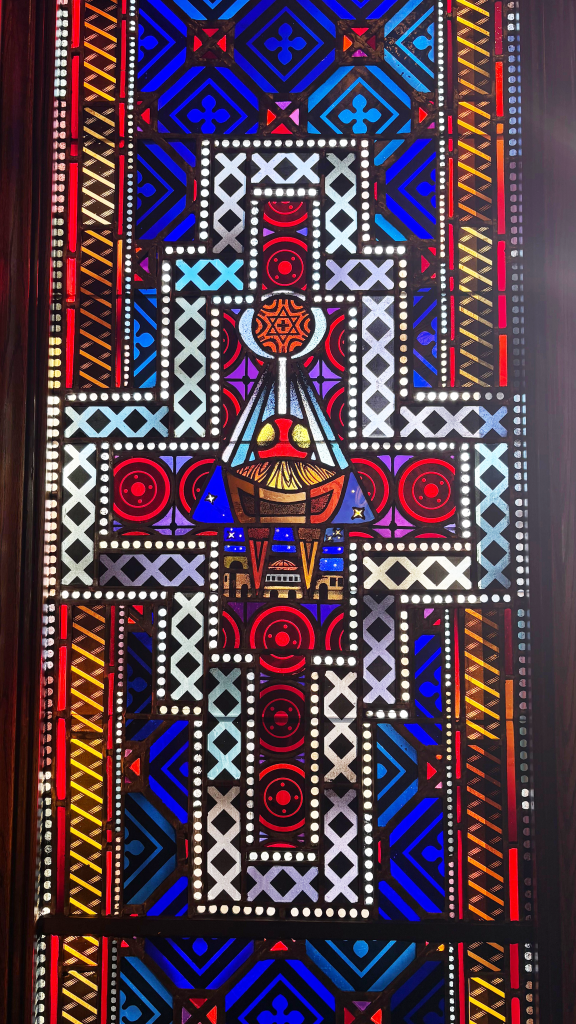
The Birth
At the center of the cartouche is a stylized manger in which lay the baby wrapped in swaddling clothes. The presense of Jesus is indicated by the nimbus with three radiating shafts of red (the color of Divinity). The town of Bethlehem can be seen under the legs of the manger. Above is the star of David.
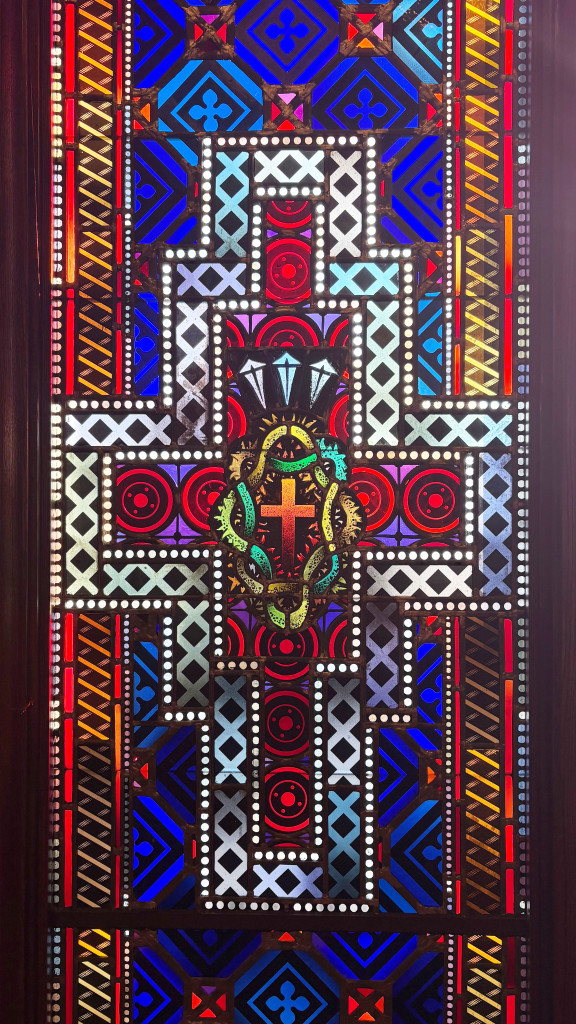
The Crucifixion
The blood-red cross is viewed through the sinister crown of thorns that was placed upon Christ’s head. The inner circle of thorns is red to represent the cross being stained by blood from the Savior’s brow. Three stylized nails for his hands and feel complete the window.
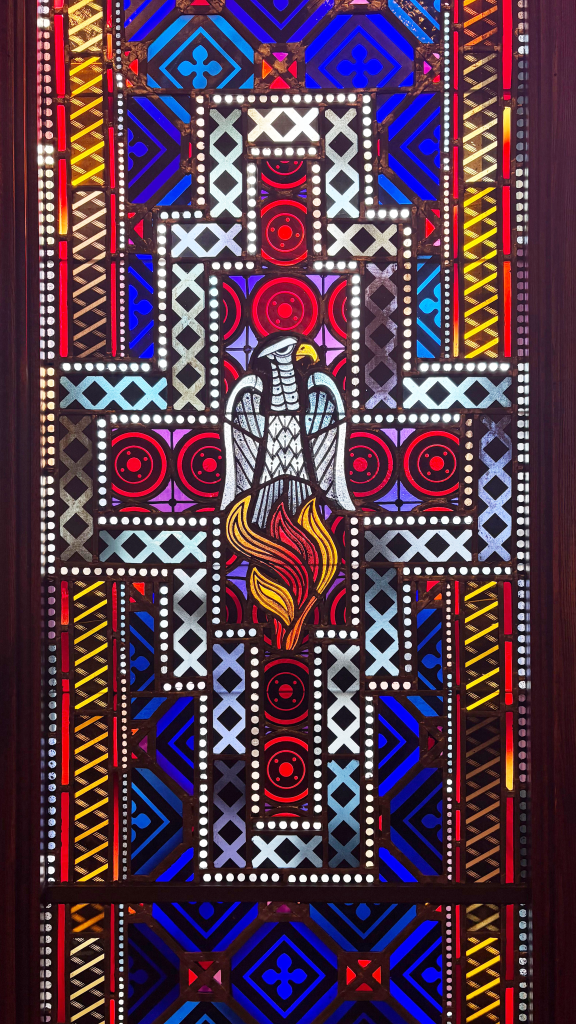
The Resurrection
The legend of the phoenix was introduced to Christianity in the first century by St. Clement. Our window follows his tradition by using the phoenix as representation of the resurrection of Christ. The window also has addition significance for FPCA since the phoenix rose again after the 1988 fire.
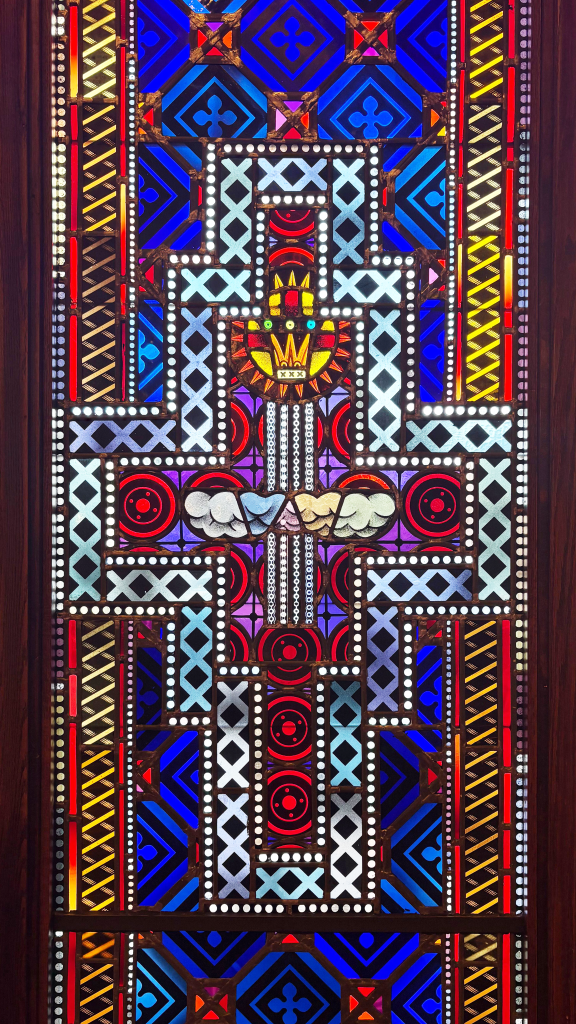
The Ascension
The return of Jesus to heaven after his resurrection is represented with a crown emblazoned on a golden nimbus, with rays of light emanating from all around the circumference. Shafts of light from the crown penetrate the clouds to reach the region here below as a sign of the presence of God.
The Old Testament Windows
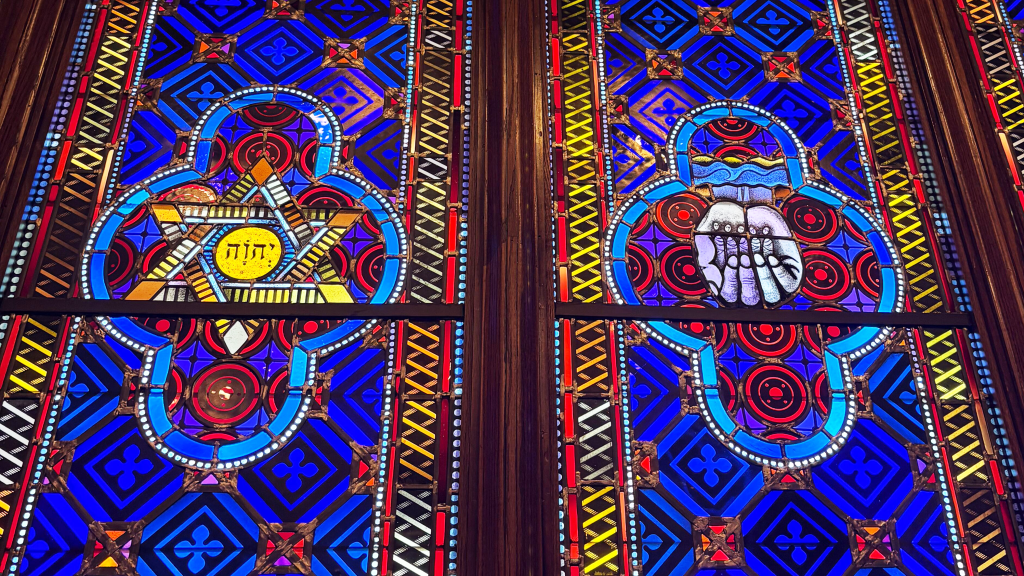
The Name of God
“And God said to Moses, ‘I AM WHO I AM…. this is My name forever, and this is My memorial to all generations.'” – Exodus 3:14
The large six-pointed star is composed, familiarly, of two interlaced equilateral triangles known as the Star of David. In the center is the Hebrew word for the name of God.
The Hand of God
“Thy right hand shall hold me…” – Psalm 139
“… the righteous and the wise and their works are in the hand of God.” – Ecclesiastes 9:1
The hand of God extends from a bright cloud. Within are five tiny figures representing the souls of the righteous.
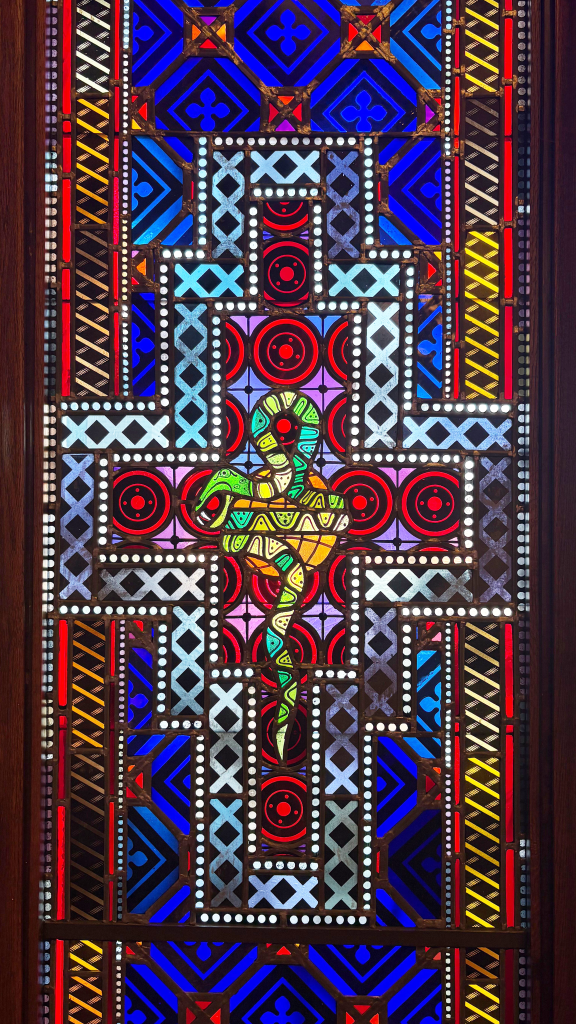
The Creation and Fall
This picture of creation is one in which humans inherit a world encoiled by the grip of sin, represented by the serpent. Thankfully the lock of evil on this world is temporary. God will come to redeem the world.
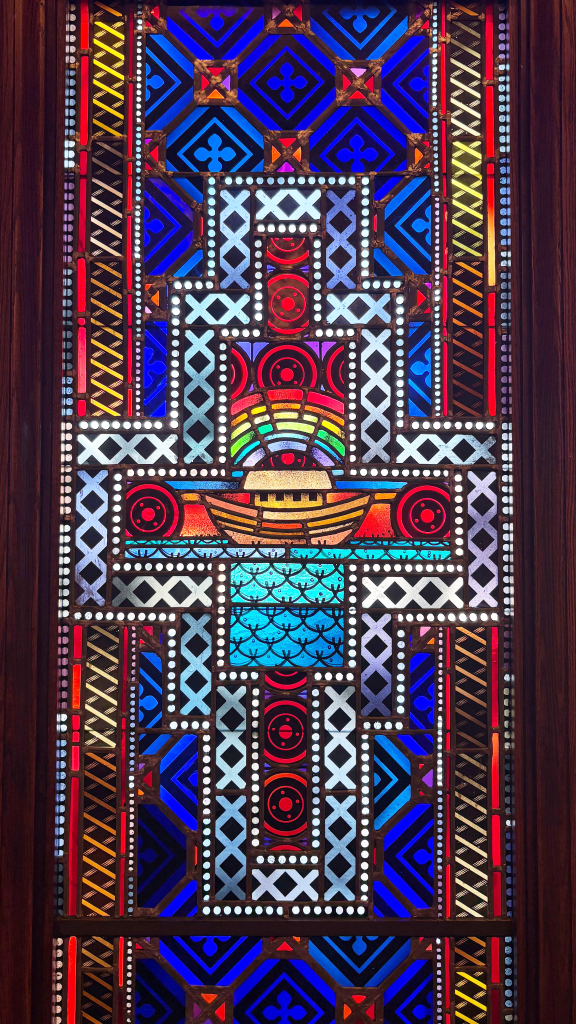
The Covenant with Noah
Genesis tells a story of Noah, the last man (along with his family) devoted to God. So, God sent a flood to eradicate life from the earth and begin again, saving only Noah with pairs of animals via an arc. As a sign that God would never again send a flood, God set a rainbow in the sky.
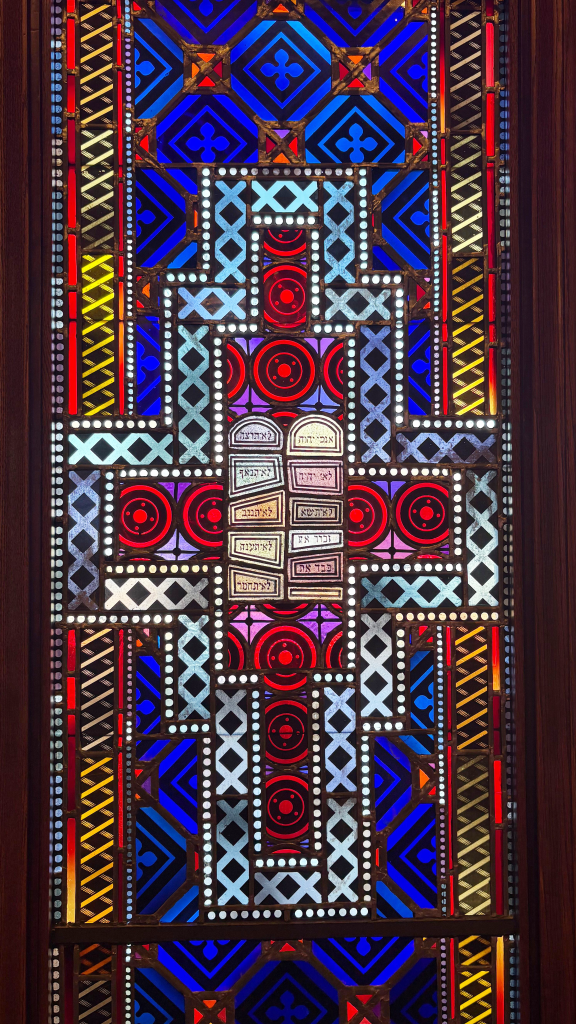
The Ten Commandments
The ten commands of God given to God’s people are represented here as tablets of the law. Read right to left are ten words in Hebrew, the first four describing people’s relationship to god. The next six dictate the law between people.
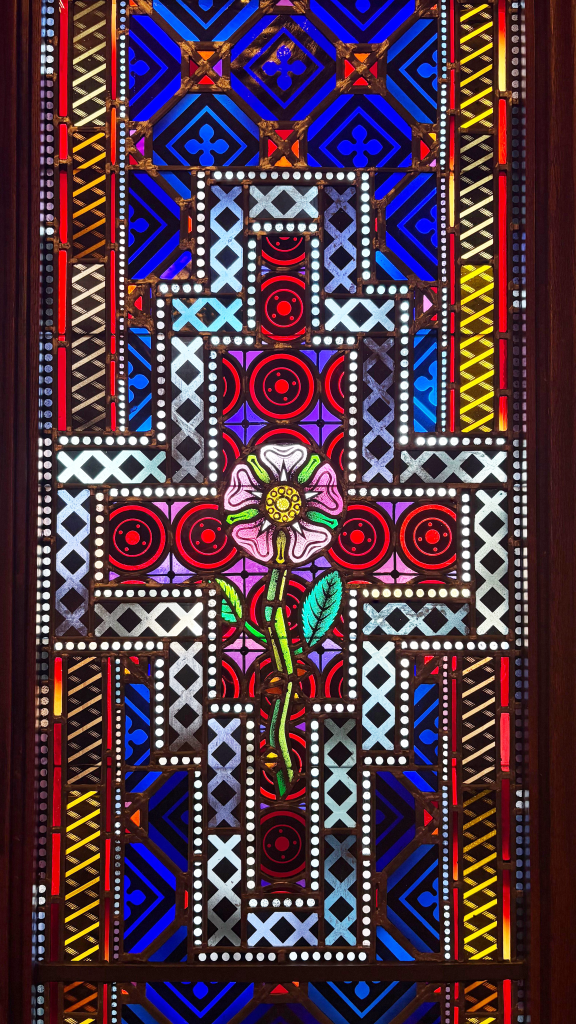
The Prophetic Concept
As Old Testament scriptures point to Jesus as a blooming rose (or crocus) our window points to the coming of Christ. Note that the rose is pink, a marriage of red (divinity) and white (humanity). At the heart of the rose is a five-pointed star symbolizing the five wounds of Christ.